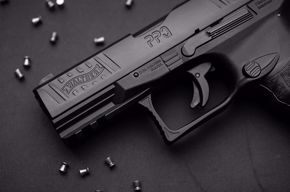
CO2 cylinders provide a handy power source for many
air pistols and air rifles. As the design of this type of gun evolves, we discover new problems
with CO2 air gun cartridges.
Take a close look at the valve where your CO2 cartridge fits into the airgun.
If the cartridge simply presses against a seal, you're ok. If your cartridge
slides through an O-ring, you could be in trouble if you use the wrong
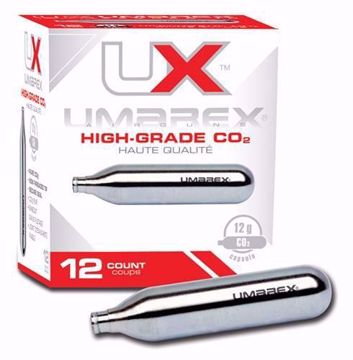
kind of cylinder. Take a look at the three CO2 cylinders below:
1. The cylinder on
the left is totally crimped on.
2. The one in the middle has a crimped on top that
leaves a groove around the neck.
3. The one on the right has a smooth neck. This
can be used in either type of air gun.
DO NOT USE EITHER OF THE FIRST TWO CYLINDERS IF
YOUR CARTRIDGE SLIDES THROUGH AN O-RING. The type
on the right is okay for any style airgun. We recommend
Walther 12g CO2 Cylinders. BUY a 12 pack of Walther CO2 cylinders NOW.
REMOVING A CO2 CYLINDER
Put your airgun “ON SAFE”.
With the muzzle pointed in a safe direction and hands away from the cylinder, slowly
untighten the puncture mechanism allowing any remaining gas to
be discharged.
Remove and properly dispose of CO2 cylinder.
CAUTION: Never attempt to reuse a CO2 cylinder for any purpose.
Use and Handling of CO2 CYLINDERS
It is possible that certain conditions may affect a CO2 cylinder, which
can impact
its proper performance. These conditions include usage, maintenance
and storage at temperatures that are higher or lower than normal outdoors
temperatures (59°F/15°C to 69.8°F/21°C). Another condition
may be when the gun is fired rapidly.
1. High temperatures can increase pressure in the CO2 cylinder and
also within
the gun, leading to higher than standard operating pressure. This excess
pressure
could cause the gun to malfunction or be permanently damaged. Maximum
storage or operation temperature should never exceed 122°F (50°C).
This temperature
can be reached if you leave the gun under direct sunlight on a bright
day. Thus, to
ensure proper gun operation, do not expose it to high temperatures
or direct sunlight
for long periods of time. Otherwise, the CO2 cylinder could overheat
and explode,
which could damage the airgun and cause injuries or death to people
nearby.
2. Fast consecutive shooting may produce a decrease of temperature in
the gun,
as well as the CO2 cylinder. This could result in lower projectile velocities
and may
even lower gas pressure enough so that the pistol will not fire. This
condition can be
especially apparent when shooting in cold weather and can be avoided
by allowing
more time between shots. This permits the gas to increase in temperature
and pressure
and produce normal velocities.
3. During rapid fire, the muzzle velocity of each shot will diminish.
This can affect
shooting accuracy and you will get fewer shots per CO2 cylinder.
4. Care should be exercised to ensure that the gun is not shot with a
CO2 cylinder
that is low in pressure. Here are some indicators of insufficient pressure:
A) The sound of the shot is not as loud as when the cylinder is full.
B) The projectile hits the target, but in a lower position than it would
with a full
CO2 cylinder (that is, the shooting speed has dropped).
WARNING: A CO2 CYLINDER CONTAINS GAS UNDER PRESSURE,
WHETHER OR NOT IT HAS BEEN INSERTED INTO A GUN. IF EXPOSED TO
HIGH TEMPERATURES (SUCH AS INSIDE A CLOSED CAR AND/OR IN DIRECT
SUNLIGHT) IT COULD EXPLODE. STORE ALL CYLINDERS IN A COOL PLACE.
CAUTION: Keep hands, face, and other exposed skin away from escaping
CO2 gas. CO2 is very cold and can cause serious injury, including frostbite.
|