


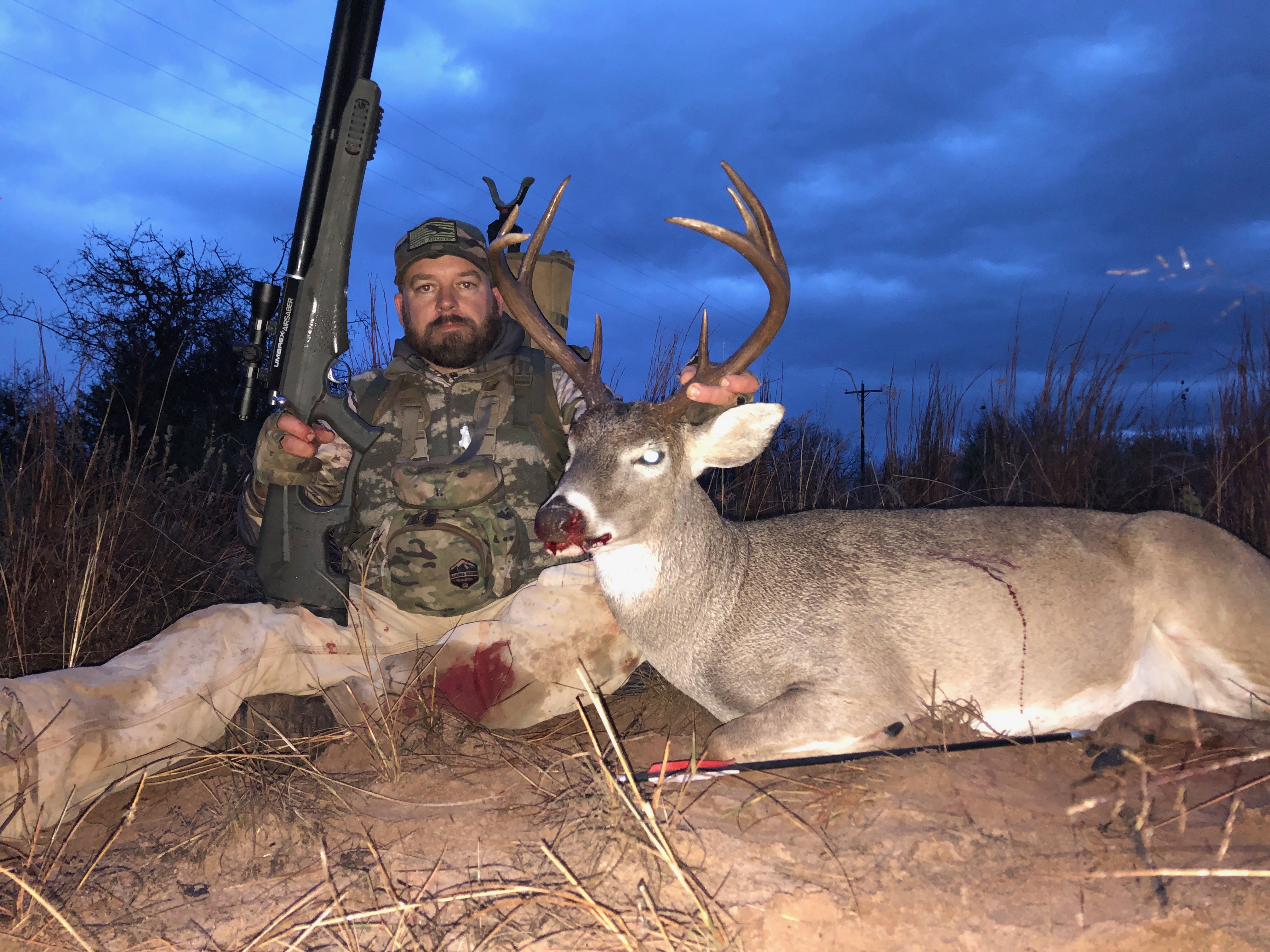
Hunter and gunsmith Steve Criner with a deer he took with Umarex’s AirSaber.
This blog is for hunters. If you aren’t a hunter you might want to stick around as you might find this topic interesting.
In the bowhunting world the topic of jumping the string is well known. There are two major factors hunters need to consider when hunting and taking a shot. The first being the speed of the projectile and the second being the speed of sound. In rifle hunting, this isn’t an issue since any supersonic projectile will arrive at your target long before the sound does. “Long” here is relative. In reality, we are talking about fractions of a second. But it is those fractions of a second that really matter when you are dealing with a projectile that is traveling far below the speed of sound.
Before I go further, I need to reference the baseline velocity calculation used in modern archery. Most bow companies agree that using a 350-grain arrow is the standard for measuring velocity with a bow.
In the archery category you will find velocities ranging from around 220 feet per second with lower draw weight recurve bows and touching 370 FPS with the fastest compound vertical bow.
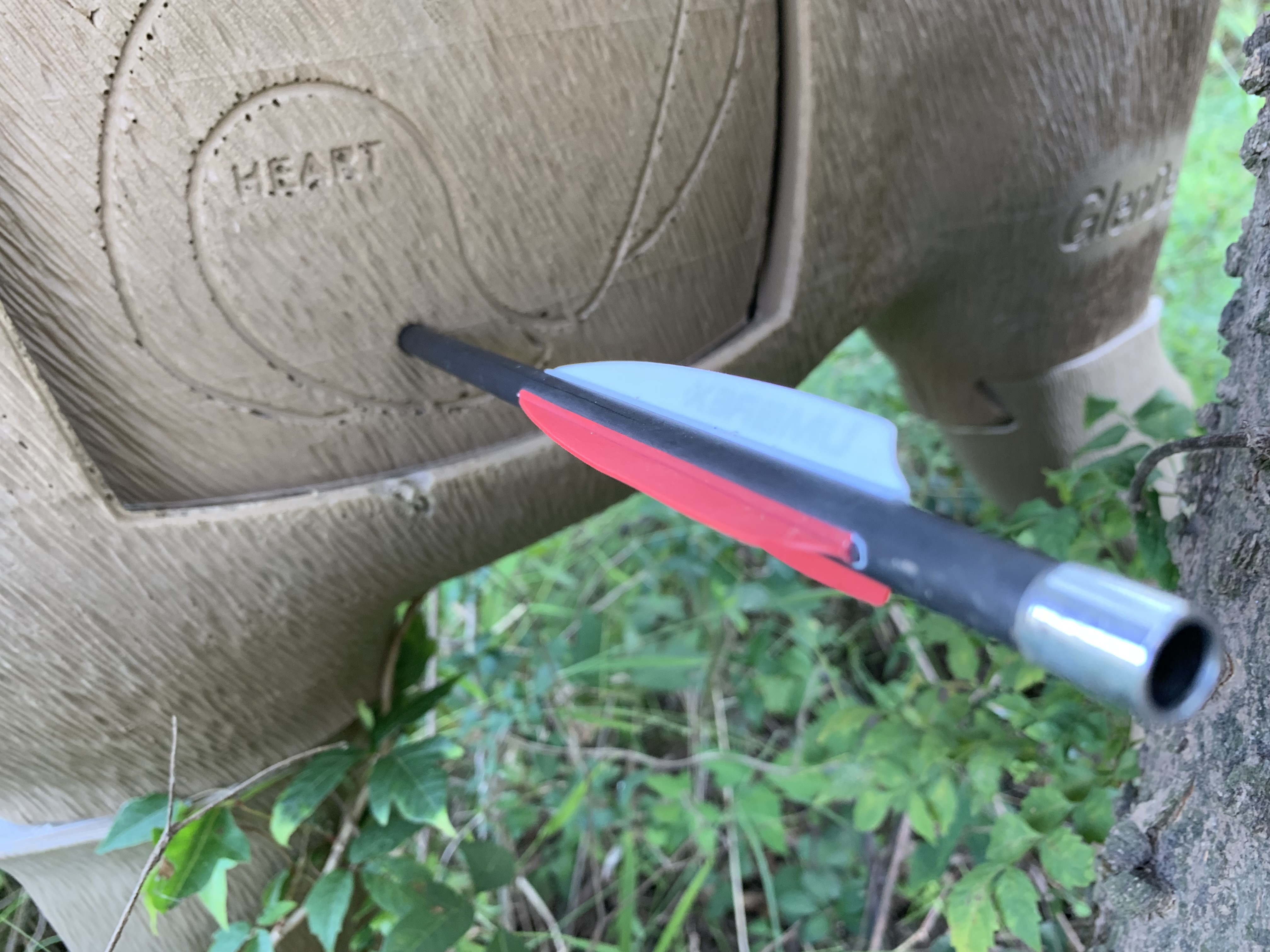
Aiming at the lower 1/3rd of the vitals area is essential, whether the deer “jumps the string” or not.
Crossbows tend to produce more energy and more velocity as well. Some crossbows will shoot in the 480 FPS range, but it is common to see numbers between 370 to 400 FPS. All of these figures are calculated using a 400-grain bolt and head combination.
Umarex’s original AirSaber comes with 376-grain arrows which are rated at 450 FPS. To translate this into the vertical bow category using a 350-grain arrow, the AirSaber will shoot at 465 FPS. Using the 400-grain crossbow weight, the AirSaber will produce 435 FPS.
New for 2026 we will see the AirSaber Alpha, a premium edition of the AirSaber, that produces 475 FPS with the factory 376-grain arrow, 492 FPS with a 350-grain arrow, and 461 FPS with a 400-grain arrow.
Anyway you slice it, your arrow is moving, at best, less than half of the speed of sound (1,086 FPS at 32 degrees, sea level). While vertical bows are pretty quiet, especially when compared to a firearm, even the most quiet bow shot will alert a deer. In other words, your arrow is chasing the sound of its release.
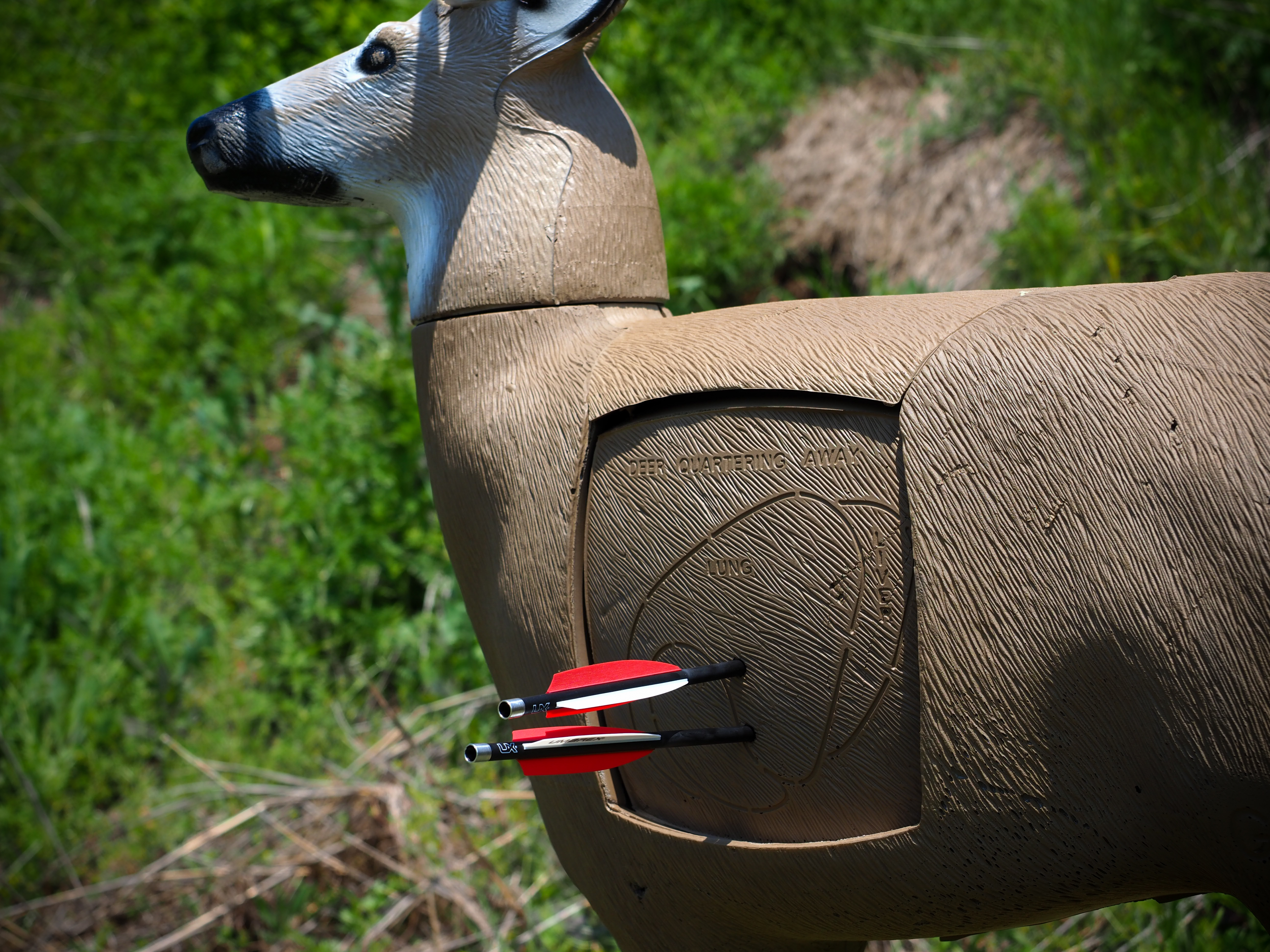
These arrows are grouped approximately 10 inches below the top of the deer’s body, Once alerted the deer can drop 10 inches in a fraction of a second.
In one tenth of a second a sound will travel about 36 yards. For every yard beyond that distance a few hundredths of a second are added to that tenth until you get to about 76 yards where approximately two tenths of a second will have elapsed since the initiating sound, and in the 100-yard range, approximately three tenths of a second will pass before the sound arrives.
As said earlier, a supersonic rifle shot will arrive a long time before the sound does, even at these close ranges, but the story is different with any sort of arrow shot.
From the lowest velocity recurve bow to the fastest crossbow on the market, the distance to the target is crucial. If you were shooting a static target, this would not matter, but deer and elk are hyper aware of their surroundings and tend to react instantly to unnatural sounds once they reach their ears.
The following chart demonstrates velocities in 20 FPS increments over distances starting at 30 yards and in 10-yard increments out to 100 yards.The number in parentheses indicates the flight time of the arrow after sound arrives at the noted distance.
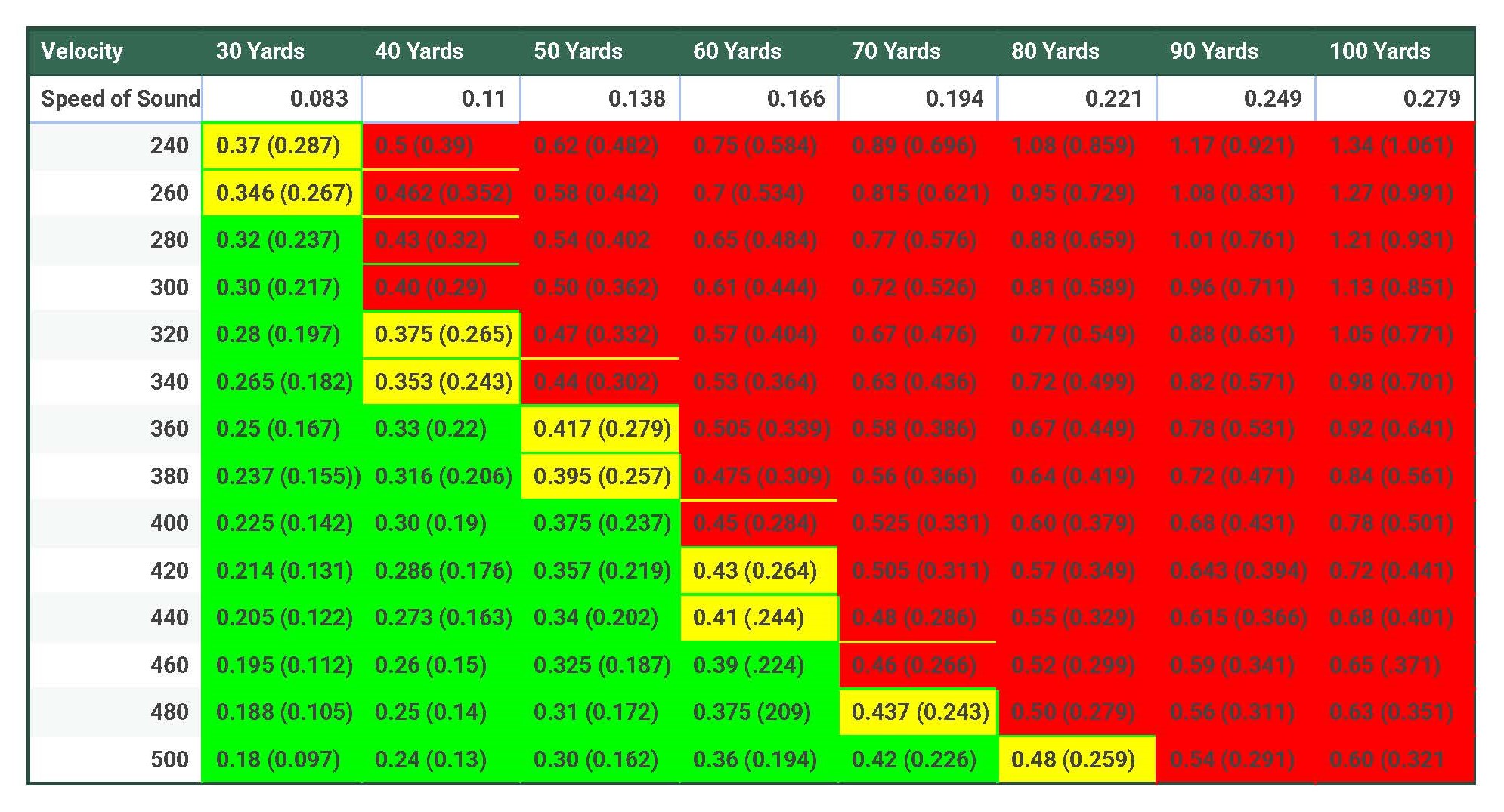
Factors such as brush density, wind, and the particular level of alertness of the deer can lead to missed shots at even the distances colored green. Hunting, afterall, is never a guaranteed thing.
Using the most widely hunted game animal in North America, the whitetail deer, Dr. Grant Woods and engineer Darren Cummings teamed up to quantify the phenomenon in question, jumping the string. To call it jumping the string is slightly misleading – the deer isn’t jumping anywhere, it is dropping to the ground, or at least close to it. In the graph above, both the arrow flight time and the time it takes the sound to reach the target are considered. Once the animal is alerted to the shot, odds are it will react by dropping towards the ground before running.
The total shot time needed for a shot on a deer needs to be pretty no more than ¼ of a second plus the time it takes the sound to reach the animal to ensure, in the event the deer doesn’t drop, you can still place an ethical and quickly lethal shot. Dr. Woods found that at 40 yards a deer could drop as much as 10 inches once alerted to the shot. This downward movement takes nearly ¼ of a second. After that, the deer is moving away in four wheel drive with a nitromethane dragster engine providing the go! The best practice for archery hunting is to aim at the lower 1/3rd of the vitals to accommodate for the deer dropping or not dropping and still delivering a humane harvest.
Accuracy at distance with your archery equipment is also of the utmost importance. It’s fairly easy to stack arrows inside of a small circle at 20, even 30 yards, but out beyond 50 yards, it becomes much more difficult to be consistent. Some hunters might find the data on the range graph a bit conservative and that is fine. This is a baseline for arrow hunters to use to gather their own data and practice with the equipment they plan to use.
I highly recommend checking out the video Dr. Woods and the team at Growing Deer TV made. It is really a wonderful resource to see why and how they came to their conclusions.
Mark Davis, avid outdoorsman, family man, and outdoors writer is the eCommerce Marketing Manager for Umarex USA.