




CO2 vs NitroAir Air Rifles: Key Differences in Performance and Consistency
Quick Answer
CO2 and NitroAir air rifles can look similar at first because both use cartridges and both are easier to operate than spring or gas ram rifles. But they are not the same kind of system. CO2 rifles use compressed carbon dioxide and are usually aimed at easy, casual shooting with low effort between shots. NitroAir uses high-pressure nitrogen cartridges in designated rifles and is built around a more advanced, PCP-style operating model.
For many shooters, CO2 is the simpler and more familiar option. It works well for backyard plinking, casual target shooting, and beginner-friendly use. NitroAir is aimed at a different kind of buyer. It is for shooters who want a cartridge-based system, but with a different pressure model and a simpler path into regulated, higher-pressure air rifle ownership.
The better system depends on what you are really trying to solve. If you want easy, approachable shooting and a platform that feels intuitive right away, CO2 often makes more sense. If you want a smoother entry into higher-pressure shooting without a compressor, hand pump, or air tank, NitroAir becomes much more compelling. For the full system overview, see Air Rifles 101: Power Systems, Accuracy, and How to Choose the Right One (https://www.umarexusa.com/air-rifles-101-guide). For the NitroAir concept page, see What Is NitroAir? How Nitrogen-Powered Air Rifles Work (https://www.umarexusa.com/what-is-nitroair-air-rifle).
Why CO2 and NitroAir Get Compared So Often
The reason buyers compare CO2 and NitroAir so often is simple. Both systems avoid the cock-before-each-shot rhythm of spring piston and gas ram rifles. Both use cartridges. Both offer an easier shooting experience than a traditional break barrel mechanical platform. From a distance, they can seem like they belong to the same category.
That surface similarity is exactly why this comparison matters.
A buyer who sees only the cartridge may assume both systems solve the same problem in the same way. They do not. CO2 is usually about ease, familiarity, and casual use. NitroAir is about making a higher-pressure, PCP-style experience easier to own. Those are related goals, but they are not identical.
That difference becomes much more important after the purchase than it does before it. Before you buy, both may sound like “easy air rifles.” After you buy, one may feel like a simple backyard rifle while the other feels like a more advanced platform with a very different ownership logic. That is why this page needs to be more than a basic spec comparison.
What CO2 Air Rifles Actually Are
A CO2 air rifle uses compressed carbon dioxide stored in cartridges to power each shot. This is one of the most familiar cartridge-based airgun systems on the market, and it remains popular for very good reasons. It is approachable, simple to understand, and usually easy to live with.
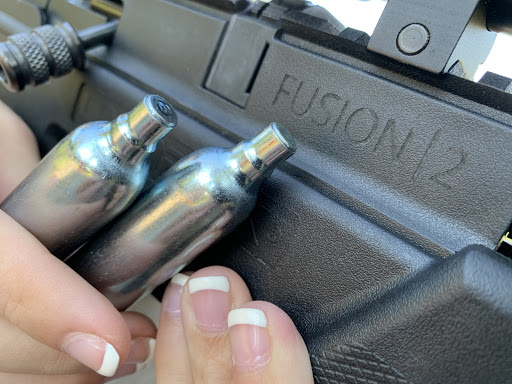
The Umarex Fusion 2 Quiet CO2 Pellet Rifle (https://www.umarexusa.com/umarex-fusion-2-quiet-co2-pellet-rifle-177-compact-airgun) is a strong example of what makes CO2 appealing. It is built for easy operation, quiet shooting, and multi-shot use. Umarex says it can run on two 12-gram CO2 capsules or an 88-gram cylinder, and the platform is clearly designed around convenience and repeatable casual use.
That matters because the appeal of CO2 is not just the gas itself. The appeal is the overall ownership experience. CO2 rifles usually feel more relaxed and less demanding than mechanical air rifles. They are often easier to recommend to someone who wants to shoot more often without spending much time thinking about the mechanics between shots.
The limitation is that CO2 is more affected by temperature and fast shooting than a purely mechanical system. That does not make CO2 a bad choice. It just means that its strengths are most obvious when the shooter values ease and convenience more than pressure stability across changing conditions.
What NitroAir Air Rifles Actually Are
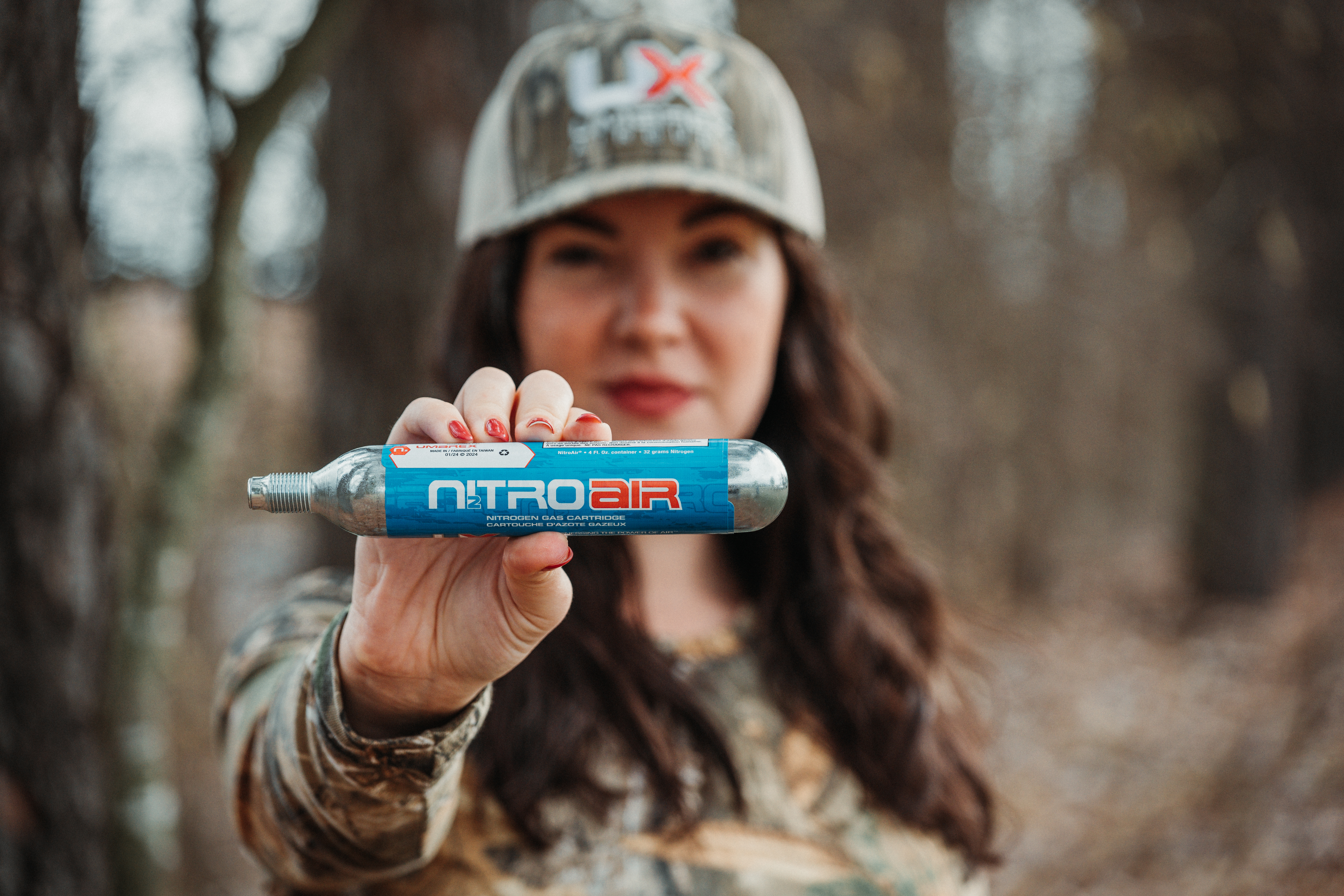
NitroAir is Umarex’s high-pressure nitrogen cartridge system for designated N2 airguns. Instead of using carbon dioxide, the system uses disposable pre-filled nitrogen cartridges that Umarex states are filled to 3,600 psi. That is a major difference in both pressure model and intended platform.
The NitroAir pre-filled cartridges (https://www.umarexusa.com/umarex-nitroair-prefilled-nitrogen-cartridges-2pk-2211382) are not designed to make a CO2 rifle work differently. They are designed for a different class of rifle. The Komplete NCR .177 (https://www.umarexusa.com/umarex-komplete-ncr-177-pcp-air-rifle-2251556) and Komplete NCR .22 (https://www.umarexusa.com/umarex-komplete-ncr-22-pcp-air-rifle-2251558) are built around that system and positioned as PCP-style rifles that do not require a pump, compressor, or tank.
That changes the conversation immediately. NitroAir is not just another convenience cartridge. It is a way of packaging higher-pressure shooting into a simpler ownership format. That is why it attracts a different type of buyer than a standard CO2 rifle does.
In practical terms, NitroAir is for the shooter who wants easier operation than a break barrel or gas ram rifle, but who also wants a more a more powerful system than thel CO2 platform can offer. It is not the “next step” for every buyer, but it is a very specific answer to a very real problem in airgun ownership.
The Real Difference: Pressure, Platform, and Ownership Model
The most important difference between CO2 and NitroAir is not just the gas. It is the kind of rifle each one supports.
CO2 is typically associated with recreational, easy-to-use air rifles built around convenience. It is a strong fit for relaxed backyard practice, plinking, and entry-level use. The whole system is familiar, approachable, and easy to understand for people who do not want to think much about airgun infrastructure.
NitroAir supports a different type of platform. It is built around high-pressure nitrogen cartridges and designated rifles that are intended to feel more like a simplified path into PCP-style ownership. That means the question is not simply “Which cartridge is better?” The real question is “Which ownership model fits me better?”
That shift matters because it reframes the decision. A casual backyard shooter may not need anything beyond the strengths of CO2. A buyer who wants a more advanced shooting system, but does not want the burden of external fill gear, may see far more value in NitroAir. The systems are not direct substitutes in every use case, even though they can appear similar at first glance.
CO2 vs NitroAir on Ease of Use

If you define ease of use as low effort between shots, both systems score well. Neither requires the repetitive cocking cycle of a spring or gas ram rifle. That immediately makes both systems appealing to people who want a faster, smoother shooting experience.
CO2 still has the edge in familiarity. Many shooters already understand what a CO2 cartridge system is, and the learning curve is usually very light. A rifle like the Umarex Fusion 2 Quiet CO2 Pellet Rifle (https://www.umarexusa.com/umarex-fusion-2-quiet-co2-pellet-rifle-177-compact-airgun) is the kind of product that makes this obvious. Load pellets, install the gas source, and shoot.
NitroAir is also easy to use in the physical sense, but its value is more specialized. The convenience is not just that it avoids cocking. The convenience is that it avoids the normal support gear tied to PCP-style shooting. That means NitroAir can feel easy in a more strategic way. It simplifies ownership at a different level.
So if the question is “Which one feels simpler on day one?” CO2 often wins. If the question is “Which one makes a more advanced platform easier to own?” NitroAir is the stronger answer.
CO2 vs NitroAir on Consistency and Performance Behavior
This is where the comparison becomes more meaningful.
CO2 rifles are practical and enjoyable, but they are more affected by temperature and rapid-fire cooling. Umarex’s own CO2 cold-weather guidance explains that colder conditions can reduce performance, and fast shooting can also cool the system. For a lot of recreational use, that is perfectly acceptable. But it is still a real tradeoff.
NitroAir is built around high-pressure nitrogen and a designated platform like the Komplete NCR .177 (https://www.umarexusa.com/umarex-komplete-ncr-177-pcp-air-rifle-2251556), which Umarex describes as using an internal regulator and delivering 45 or more consistent shots per cartridge in .177. That kind of positioning tells you exactly what NitroAir is trying to solve. It is designed to offer more controlled, repeatable performance in a cartridge-based system.
That does not mean every buyer needs NitroAir-level performance behavior. Many do not. But it does mean the systems are solving different problems. CO2 prioritizes convenience and accessibility. NitroAir prioritizes a simpler path into regulated, higher-pressure shooting behavior.
In practice, that means a shooter who cares deeply about stable performance and system refinement is more likely to appreciate NitroAir. A shooter who mainly wants easy, fun, low-friction backyard use may still find CO2 the more sensible answer.
CO2 vs NitroAir for Backyard Shooting
Backyard shooting is one of the most useful ways to compare these systems because it highlights what most people actually care about: ease, repeatability, comfort, and practicality.
CO2 is often the most natural backyard answer because it feels uncomplicated. It is easy to operate, easy to explain, and well suited to short practice sessions or relaxed plinking. If the shooter wants a casual rifle that is fun to use and does not demand much effort, CO2 is usually the fastest recommendation.
NitroAir can absolutely work in a backyard context, but usually for a different kind of user. It makes more sense for someone who wants a more advanced platform and likes the idea of a cartridge-driven system that feels closer to regulated PCP ownership. That buyer is not just asking for “easy.” They are asking for easy access to a more sophisticated setup.
So the better backyard system depends on the goal. If the goal is the easiest possible recreational shooting experience, CO2 usually wins. If the goal is backyard-friendly operation with a more advanced power model, NitroAir becomes more attractive. For the dedicated use-case page, see Best Air Rifle Power System for Backyard Shooting, Beginners, and Accuracy (https://www.umarexusa.com/best-air-rifle-power-system-guide).
CO2 vs NitroAir for Beginners
For most beginners, CO2 is still the easier recommendation. It is familiar, simple, and forgiving in the sense that it reduces the amount of physical and mechanical effort required between shots. That lets a new shooter focus on sight picture, trigger control, and basic consistency.
NitroAir can still be a beginner-friendly option, but usually for a specific kind of beginner. It fits the buyer who wants something more advanced from the beginning and is specifically interested in the idea of a higher-pressure system without external fill gear. That is a valid beginner profile, but it is not the default one.
This distinction matters because “beginner-friendly” does not always mean the same thing. Sometimes it means the easiest possible operation. Sometimes it means the easiest possible path into a more advanced category. CO2 is better at the first definition. NitroAir is a better fit for the second.
If the buyer is simply asking for the easiest starting point, CO2 is usually the cleaner answer. If the buyer is asking how to skip some of the normal friction around PCP-style ownership, NitroAir becomes much more interesting.
Which One Is Better?
The honest answer is that neither one is better in every way. They are better at different things.
CO2 is usually better for buyers who want familiarity, simplicity, easy operation, and relaxed recreational use. It is especially strong for backyard shooting, casual plinking, and first-time buyers who want to start with as little friction as possible.
NitroAir is usually better for buyers who want a different kind of performance model and a simpler entry into regulated, higher-pressure shooting. It is not trying to be the same thing as CO2. It is trying to make a more advanced ownership experience easier to access.
So the better question is not “Which one wins?” The better question is “Which tradeoff would I rather live with?” If your answer is cartridge convenience and casual ease, CO2 usually wins. If your answer is simpler access to a more advanced platform, NitroAir wins.
That is the real decision.
Key Takeaways
-
CO2 and NitroAir are both cartridge-based air rifle systems, but they are not built to solve the same problem.
-
CO2 is usually the more familiar, casual, and beginner-friendly option.
-
NitroAir is designed to provide a simpler path into higher-pressure, PCP-style shooting without compressors or hand pumps.
-
CO2 is often the easiest answer for backyard shooting and relaxed plinking.
-
NitroAir is often the better answer for buyers who want a more advanced cartridge-driven platform.
-
For the next step in the cluster, see What Is NitroAir? How Nitrogen-Powered Air Rifles Work (https://www.umarexusa.com/what-is-nitroair-air-rifle) and Best Air Rifle Power System for Backyard Shooting, Beginners, and Accuracy (https://www.umarexusa.com/best-air-rifle-power-system-guide).
FAQ
Is NitroAir better than CO2?
Not for every shooter. NitroAir is better for buyers who want a simpler path into a higher-pressure, PCP-style platform. CO2 is often better for buyers who want easier, more familiar recreational shooting.
What is the main difference between CO2 and NitroAir?
The main difference is the platform each system supports. CO2 is generally tied to easy, recreational cartridge-powered shooting. NitroAir uses high-pressure nitrogen in designated rifles built around a more advanced PCP-style ownership model.
Is CO2 easier to use than NitroAir?
For many shooters, yes. CO2 is usually more familiar and more immediately intuitive. NitroAir is also easy to operate, but its value is tied more to simplifying advanced air rifle ownership than to sheer simplicity.
Which is better for backyard shooting, CO2 or NitroAir?
CO2 is usually the simpler backyard answer for relaxed target shooting and plinking. NitroAir can also work very well in a backyard setting, but it is often a better fit for someone who wants a more advanced cartridge-based system.
Do NitroAir rifles need a compressor?
No. That is one of the main reasons the system exists. The Komplete NCR .177 (https://www.umarexusa.com/umarex-komplete-ncr-177-pcp-air-rifle-2251556) is built around NitroAir cartridges so the shooter can avoid the normal compressor, pump, or tank setup.
Can a NitroAir cartridge be used in a CO2 rifle?
No. Umarex specifically notes that NitroAir cylinders are for designated N2 airguns and will not work in CO2 rifles like the Umarex Fusion 2 Quiet CO2 Pellet Rifle (https://www.umarexusa.com/umarex-fusion-2-quiet-co2-pellet-rifle-177-compact-airgun).
Works Cited
-
Umarex USA. “Umarex Fusion 2 Quiet CO2 Pellet Rifle .177 Compact Airgun.” Umarex USA. https://www.umarexusa.com/umarex-fusion-2-quiet-co2-pellet-rifle-177-compact-airgun
-
Umarex USA. “Umarex Komplete NCR .177 PCP Air Rifle.” Umarex USA. https://www.umarexusa.com/umarex-komplete-ncr-177-pcp-air-rifle-2251556
-
Umarex USA. “Umarex Komplete NCR .22 Caliber NitroAir PCP Pellet Rifle.” Umarex USA. https://www.umarexusa.com/umarex-komplete-ncr-22-pcp-air-rifle-2251558
-
Umarex USA. “Umarex NitroAir Prefilled Nitrogen Cartridges (2pk).” Umarex USA. https://www.umarexusa.com/umarex-nitroair-prefilled-nitrogen-cartridges-2pk-2211382
-
Umarex USA. “Using CO2 When It’s Cold Outside!” Umarex USA. https://www.umarexusa.com/using-co2-when-its-cold-outside-blog