


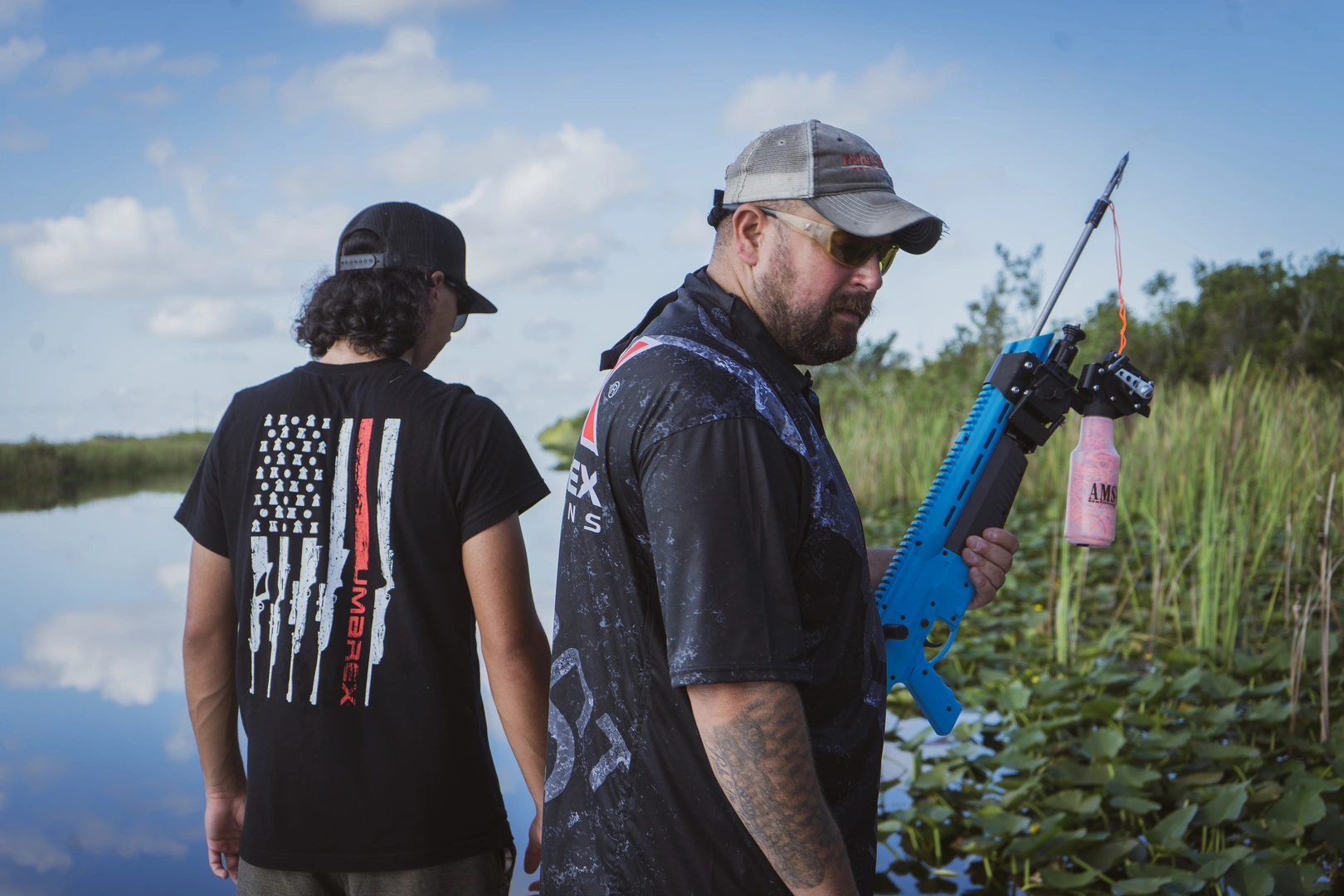
IMPORTANT LEGAL NOTICE: Air-powered bowfishing equipment, including PCP arrow-launching systems and air archery platforms, may not be specifically addressed or permitted under the laws and regulations of every state, province, water body, or local jurisdiction. Regulations involving bowfishing, spearing, airguns, arrows, fishing methods, and air-powered hunting or fishing equipment may vary significantly and may change over time. Always contact your state or local fish and wildlife agency to verify the current legality of any equipment, species, fishing method, season, or water before use. Nothing in this article should be interpreted as legal advice or as confirmation that any specific equipment or method is lawful in your area.
Quick Answer
Airgun bowfishing uses compressed air to launch a fishing arrow attached to a retrieval line. Instead of drawing a traditional bowstring, the shooter uses an air-powered arrow platform designed specifically for bowfishing applications.
Most modern air-powered bowfishing systems use PCP technology, which stores high-pressure air in an onboard reservoir and releases it in a controlled burst to propel the arrow. The arrow remains connected to a reel and retrieval line so the fish can be recovered after the shot.
Airgun bowfishing is part of the broader air archery category because it launches arrows instead of pellets or slugs. Before using any bowfishing setup, always verify the current regulations for the state, species, water body, and fishing method involved.
The Shot Starts Long Before the Trigger
Most people imagine bowfishing as the moment the arrow hits the water.
Experienced bowfishers know the shot actually begins much earlier.
It starts with reading current seams along a muddy bank. Watching shadows move across shallow water. Spotting the slow roll of a carp just beneath the surface before sunlight disappears behind glare. In moving water, even a calm-looking fish can shift position in seconds.
Airgun bowfishing changes the launch system, but it does not change those realities.
The water still moves.
Fish still react unpredictably.
Visibility still changes by the minute.
What compressed air changes is how the arrow gets there.
Instead of drawing limbs and string, an air-powered bowfishing platform stores compressed air inside a PCP system. When the trigger is pulled, regulated air pressure drives the fishing arrow forward.
The result is a different shooting experience built around the same core bowfishing fundamentals:
-
reading water
-
controlling the line
-
identifying legal fish
-
understanding angles
-
recovering the shot responsibly
That is why airgun bowfishing is best understood as a specialized form of air archery rather than ordinary airgun shooting.
For the complete category overview, see Airgun Bowfishing: The Complete Guide to Air-Powered Bowfishing Systems.
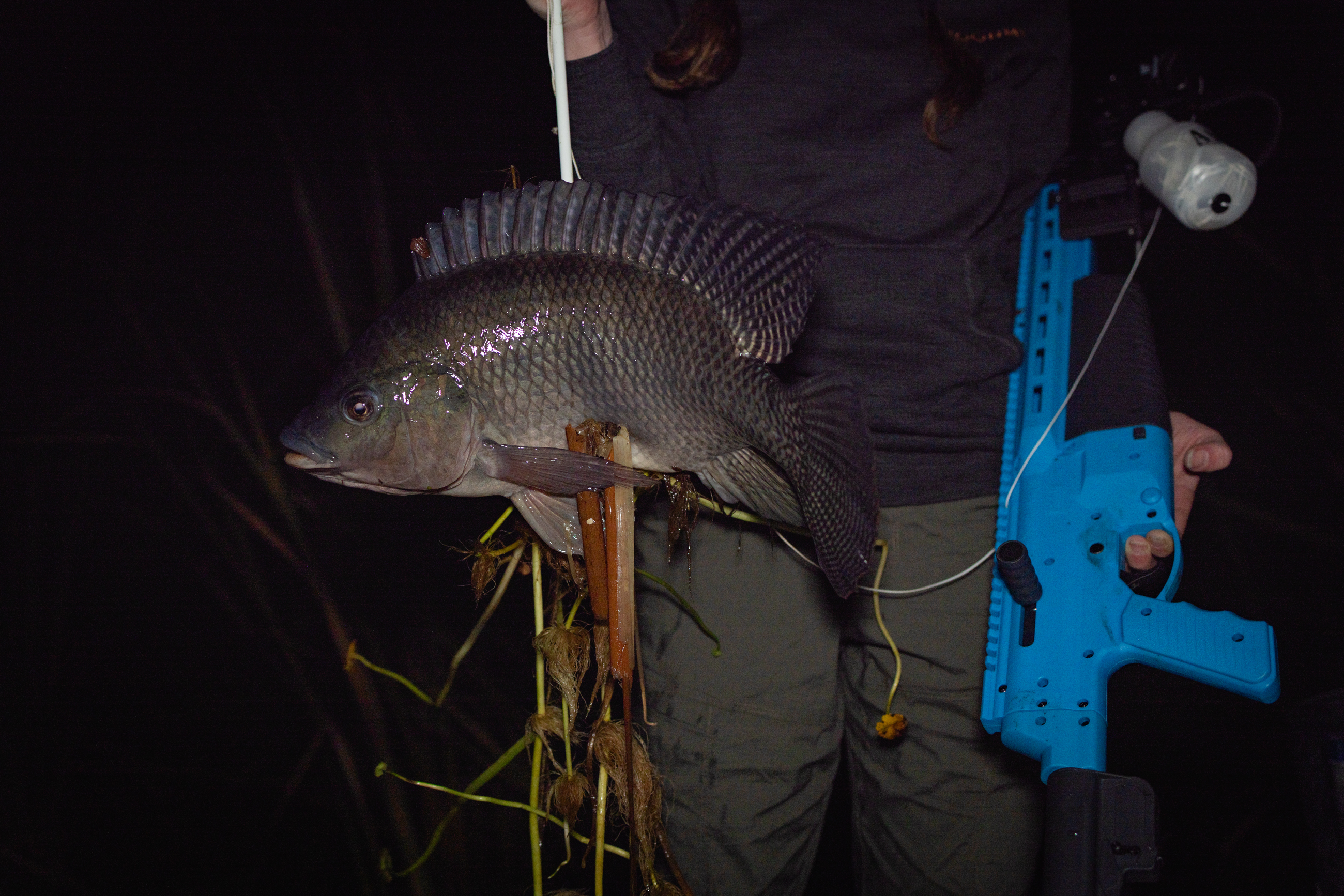
How a PCP Bowfishing System Launches an Arrow
At the center of an air-powered bowfishing setup is a PCP system.
PCP stands for pre-charged pneumatic. In simple terms, compressed air is stored inside a reservoir before the shot. When the trigger is pulled, controlled air pressure launches the arrow.
The AirJavelin FishR is described by Umarex as a PCP bowfishing airgun with a 4,500 psi onboard tank regulated to 800 psi, launching a 1,248-grain fiberglass arrow at 100 fps.
That stored pressure changes how the equipment feels on the water.
There is no draw cycle.
No bow limbs flexing under tension.
No string movement beside the shooter’s face.
Instead, the system depends on:
-
stored air pressure
-
consistent regulation
-
arrow compatibility
-
line management
-
retrieval setup
The trigger press itself is only one part of the process. Before every shot, experienced bowfishers pay attention to:
-
whether the line is clear
-
how the fish is moving
-
water depth
-
current direction
-
what lies behind the target
-
whether the fish can be identified confidently
Because bowfishing happens around water, angles and movement matter more than many beginners expect.
Why Bowfishing Arrows Are Built Differently
A fishing arrow is designed for punishment.
Unlike lightweight target arrows, bowfishing arrows must survive:
-
water entry
-
impact against fish
-
line tension
-
retrieval pressure
-
rocks
-
vegetation
-
repeated exposure to wet environments
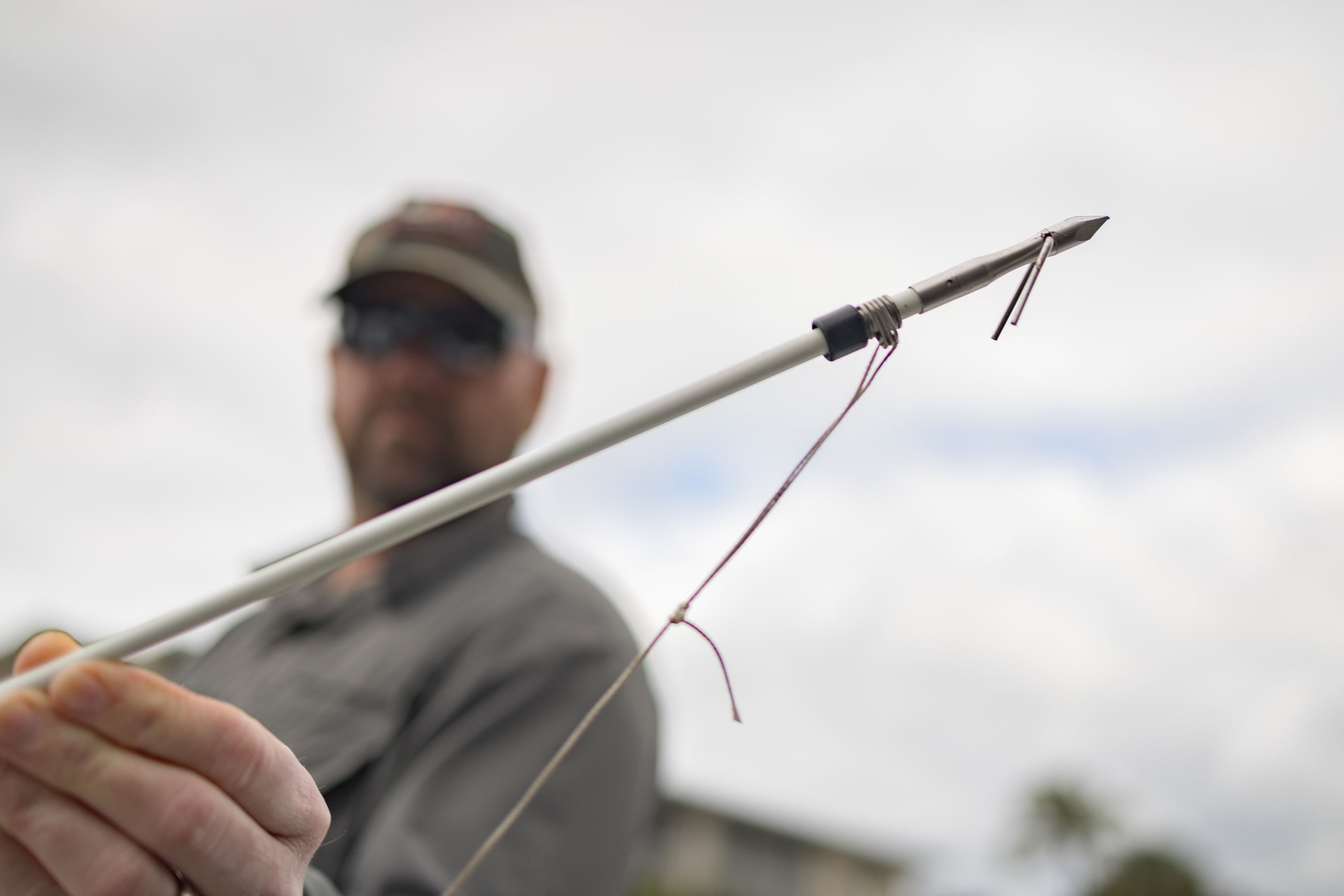
The Umarex FishR Airgun Fishing Arrow is built specifically for the AirJavelin FishR platform and uses a solid fiberglass shaft with stainless steel hardware and an Innerloc Pro Point.
That heavier construction matters in real-world conditions.
Bowfishing arrows are not designed around long-distance flight the way many target arrows are. They are built around durability, recovery, and performance in shallow-water environments where shots happen fast and equipment gets wet, dirty, and occasionally dragged through mud or vegetation.
|
Bowfishing Arrow Feature |
Why It Matters |
|
Heavy shaft weight |
Helps manage impact and retrieval stress |
|
Fiberglass construction |
Commonly used for durability |
|
Stainless steel hardware |
Better suited for wet conditions |
|
Retrieval slide system |
Allows line attachment during recovery |
|
Bowfishing point |
Helps secure fish during retrieval |
A properly matched arrow matters because bowfishing equipment works as a complete system. The launcher, line, reel, slide, and arrow all depend on each other.
For equipment guidance, see Airgun Bowfishing Setup Guide.
The Retrieval System Is Half the Sport
The arrow may get most of the attention, but the retrieval system is what makes bowfishing possible.
Once the arrow enters the water, the line becomes part of everything:
-
fish recovery
-
safety
-
equipment control
-
shot management
That line must remain clear before the shot.
Experienced bowfishers constantly check for:
-
tangles
-
wrapped line
-
line caught on vegetation
-
line trapped beneath gear
-
loose loops near hands or feet
A bad line path can ruin a shot instantly. In worse situations, it can create dangerous tension during launch or retrieval.
The AirJavelin FishR includes a universal mounting rail designed to accept common bowfishing reel systems, allowing the line to connect directly to the arrow slider in a traditional bowfishing configuration.
On the water, retrieval is rarely smooth for long.
Fish surge.
Current changes direction.
Vegetation grabs line.
Mud reduces visibility.
Boat movement changes angles.
That unpredictability is part of what keeps bowfishing exciting. Every shot becomes a combination of shooting skill, line management, and recovery control.

Water Changes Everything
The biggest adjustment for new bowfishers is learning that water changes the shot completely.
A fish is almost never exactly where it appears.
Light bends as it moves through water, causing fish to appear higher than their true position. This optical effect, known as refraction, forces bowfishers to aim lower than the visible fish.
The deeper the fish and the sharper the angle, the more important that adjustment becomes.
Then there is visibility.
Clear water creates one kind of challenge. Muddy rivers create another. Wind can distort the surface enough to hide movement completely. Sun glare can erase fish from sight in seconds. At night, artificial lighting changes depth perception and shadow contrast.
Experienced bowfishers spend as much time studying conditions as they do taking shots.
They watch:
-
current seams
-
shallow feeding movement
-
mud lines
-
changing glare
-
fish shadows
-
surface disturbances
Good equipment helps, but reading water is what separates random shooting from consistent bowfishing.
Airgun Bowfishing Is Not Regular Airgun Shooting
Compressed air may power both systems, but airgun bowfishing operates very differently from traditional airgun shooting.
A pellet rifle sends a projectile downrange and the shot is over.
Bowfishing begins after the arrow enters the water.
|
Factor |
Airgun Bowfishing |
Traditional Airgun Shooting |
|
Projectile |
Fishing arrow |
Pellet, BB, or slug |
|
Retrieval system |
Required |
Not used |
|
Primary environment |
Water and fishing conditions |
Range or field conditions |
|
Main challenge |
Refraction and recovery |
Accuracy and trajectory |
|
Equipment stress |
Water, mud, retrieval force |
Primarily firing wear |
|
Legal framework |
Fishing and bowfishing regulations |
Hunting or shooting regulations |
That difference matters for safety, equipment selection, and expectations.
Someone experienced with pellet rifles still needs to learn:
-
line control
-
fish recovery
-
water angles
-
species identification
-
retrieval safety
-
bowfishing-specific regulations
For a broader explanation of arrow-launching air systems, see What Is Air Archery?
What Beginners Usually Get Wrong
Most beginner mistakes happen before the arrow ever leaves the launcher.
The first mistake is rushing shots.
Bowfishing rewards patience more than speed. Water movement, glare, and fish behavior can make a perfect-looking shot disappear instantly. Experienced bowfishers wait for clean angles and controlled conditions rather than forcing bad shots.
The second mistake is ignoring the line.
New shooters often focus entirely on the fish and forget the retrieval system. Tangled line, poor reel setup, and blocked line paths are some of the fastest ways to create frustration or unsafe conditions.
The third mistake is treating bowfishing like target shooting.
Fish move.
Water distorts angles.
Visibility changes constantly.
Bowfishing is reactive and dynamic in ways that target shooting rarely is.
The fourth mistake is skipping legal verification.
Bowfishing laws vary by:
-
species
-
season
-
water body
-
state
-
approved methods
-
local restrictions
Texas Parks and Wildlife publishes dedicated bowfishing regulations and notes that additional restrictions may apply in certain waters and properties. (tpwd.texas.gov)
The final mistake is neglecting equipment after harsh conditions. Mud, sand, vegetation, and saltwater can wear on gear quickly if it is not cleaned and inspected properly after use.
Real Confidence Comes From Time on the Water
Bowfishing has a learning curve no article can fully replace.
You learn it through:
-
missed shots
-
changing water
-
difficult retrievals
-
sudden fish movement
-
muddy current
-
glare at sunset
-
nighttime visibility
-
shallow-water surprises
That learning curve is part of the appeal.
Every river looks different.
Every lake behaves differently.
Even familiar water changes with weather, current, temperature, and season.
Over time, experienced bowfishers stop focusing only on equipment specs and start paying more attention to conditions:
-
where fish hold
-
how current affects movement
-
how visibility changes through the day
-
when glare becomes a problem
-
how retrieval angles affect recovery
The equipment matters, but experience is what ties everything together.
For more on safe setup and preparation, see Airgun Bowfishing Safety.
Key Takeaways
Airgun bowfishing uses compressed air to launch a fishing arrow attached to a retrieval line.
PCP systems store high-pressure air that is released in a controlled burst to propel the arrow.
Bowfishing arrows are built differently than target arrows because they must handle impact, water entry, and retrieval pressure.
The retrieval system is critical for fish recovery and safe operation.
Water conditions, glare, current, depth, and refraction all affect every shot.
Airgun bowfishing is part of the broader air archery category because it launches arrows rather than pellets or slugs.
Bowfishing regulations vary by state, species, water body, and approved method, so legal verification should happen before every trip.
FAQ
How does airgun bowfishing work?
Airgun bowfishing uses compressed air to launch a fishing arrow attached to a retrieval line. The line allows the fish to be recovered after the shot.
What is a PCP bowfishing system?
A PCP bowfishing system stores high-pressure air in a reservoir and releases controlled pressure to propel the fishing arrow.
Is airgun bowfishing part of air archery?
Yes. Airgun bowfishing belongs to the air archery category because it launches arrows instead of pellets or slugs.
Why do bowfishing arrows need a retrieval line?
The retrieval line allows the shooter to recover both the arrow and the fish after the shot.
Why do bowfishers aim low?
Fish appear higher in the water than they actually are because of light refraction. Bowfishers compensate by aiming lower than the visible fish position.
Can PCP air systems be used for bowfishing?
Yes. PCP systems can power arrow-launching platforms designed specifically for bowfishing applications.
What should beginners focus on first?
Beginners should focus on safe handling, line control, water-reading skills, legal verification, and clean recovery rather than long-distance shots.
Works Cited
Umarex USA. “Umarex AirJavelin FishR.” Used for PCP system details, regulated pressure information, reel compatibility, and platform specifications. https://www.umarexusa.com/umarex-airjavelin-fishr
Umarex USA. “Umarex FishR Airgun Fishing Arrow.” Used for FishR arrow specifications, fiberglass construction, stainless steel hardware, and compatibility information. https://www.umarexusa.com/2252159
Texas Parks and Wildlife Department. “Bow Fishing Regulations.” Used for state-level regulation guidance and legal verification context. https://tpwd.texas.gov/regulations/outdoor-annual/fishing/general-rules-regulations/bow-fishing-regulations