

Quick Answer
A PCP air rifle is a pre-charged pneumatic airgun. That means it stores high-pressure air in an onboard reservoir before the shot is fired. When the trigger breaks, the rifle releases a controlled amount of that stored pressure behind the pellet, which drives the pellet down the barrel. Unlike a spring piston or gas ram rifle, a PCP does not need to build its power through a heavy cocking cycle before every shot.
In practical terms, PCP rifles feel different because they shift the work of shooting. The effort happens when you fill the rifle, not when you fire each shot. Once the reservoir is charged, the shooter usually gets multiple shots with relatively low effort between rounds. That is one reason PCP rifles are often associated with smoother shot behavior, multi-shot capability, and strong real-world consistency. Umarex’s PCP category page emphasizes accuracy, lighter ergonomic designs, and virtually no recoil when the trigger is pulled.
A PCP rifle is not one fixed type of product. It is a category of stored-pressure airguns that includes entry-level platforms, compact regulated carbines, more advanced traditional PCP rifles, and NitroAir-powered PCP variants. The category is broad enough that a first-time buyer and a more experienced PCP shooter can both be shopping for “a PCP rifle” while actually fullfilling very different ownership models.
If you are trying to understand where PCP fits in the broader category, start with Small-Bore PCP Air Rifles 101: How Pre-Charged Pneumatic Rifles Work and How to Choose the Right One. If you are already thinking about day-to-day ownership, the next step is usually How to Fill a PCP Air Rifle: Hand Pumps, Compressors, Tanks, and NitroAir Explained.
Why PCP Matters More Than Many Buyers Realize
A lot of buyers treat “PCP” like just another spec line in a product description. That usually leads to a shallow understanding of what they are actually buying. PCP is not just a technical label. It describes an ownership model, a shot behavior profile, and a completely different relationship between the shooter and the rifle.
With a spring or gas ram rifle, the shooter recreates the power cycle before every shot. With PCP, the rifle stores the air in advance. That one change affects everything from cocking effort to shot rhythm to optic friendliness. It also changes what the buyer has to think about before purchase. Fill pressure, reservoir size, regulator behavior, shot count, and fill method become central questions instead of niche technical details.
This is why PCP tends to attract a different kind of buyer than other air rifle systems. Some people are drawn to it because they want an easier shooting experience. Others are drawn to it because they want better consistency over repeated shots. Others simply want to move into a more advanced airgun category without stepping into the big-bore world.
That is also why a good PCP article cannot stop at the dictionary definition. It has to explain how the system behaves, what the parts are doing, why that matters, and what kinds of shooters actually benefit from it.
What “Pre-Charged Pneumatic” Actually Means
“Pre-charged pneumatic” sounds technical, but the definition is straightforward. “Pre-charged” means the rifle is filled with pressurized air before shooting begins. “Pneumatic” means the system uses compressed air or gas pressure as its power source. Put together, PCP means the rifle stores pressure in advance and then draws from that stored pressure as it shoots.
That definition matters because it immediately separates PCP from several other major airgun categories. A spring piston rifle is not pre-charged in the same way because it creates the working pressure during the firing cycle through a spring and piston. A gas ram rifle does something similar using a gas strut as the stored mechanical force. A CO2 rifle uses a stored gas cartridge, but not the same high-pressure onboard reservoir model associated with traditional PCP ownership. A NitroAir-powered PCP like the Komplete still belongs in the PCP family because it is a pre-charged pneumatic platform, but it changes how the charge is supplied by using removable high-pressure nitrogen cartridges instead of conventional external fill gear.
This distinction is one of the most important in the whole category. A buyer who hears “PCP” and imagines only one kind of rifle is missing the real picture. PCP is a stored-pressure architecture. It can include affordable entry-level rifles, compact carbines, regulated precision platforms, and alternative ownership branches like NitroAir.
That is why the term matters so much. It is not just a label. It is the name of the system logic.
How a PCP Air Rifle Works, Step by Step
The easiest way to understand PCP is to follow the process from fill to shot.
Step 1: The rifle is filled
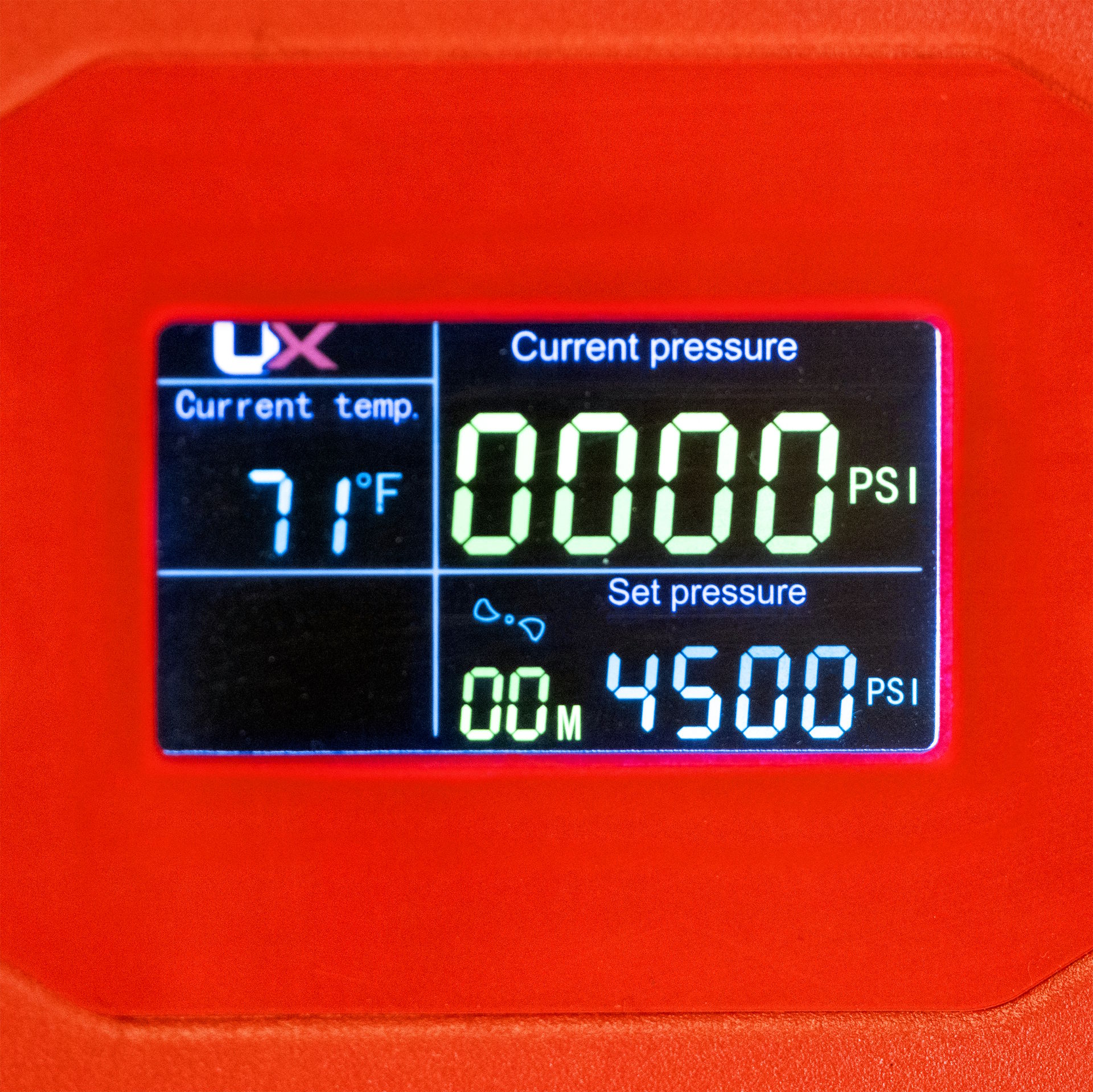
Before shooting, the rifle is charged with pressurized air or nitrogen. In a traditional PCP, that fill usually comes from a hand pump, a compressor, or a large air tank. The Umarex Origin .22 cal PCP Air Rifle Kit with Pump is one of the clearest examples of an entry-level PCP built around that model because Umarex sells it as a kit with a 4,500 PSI hand pump and says the rifle uses a patented pre-pressurized tank system that cuts pumping down by half.
Umarex also says the Origin takes about 120 pumps to completely fill the tank, can produce about 40 shots per fill, and can deliver one full-power shot after only 13 pumps. Those details are a good reminder that PCP is not just about the rifle’s barrel or stock. It is about how air is managed before the trigger is ever pulled.
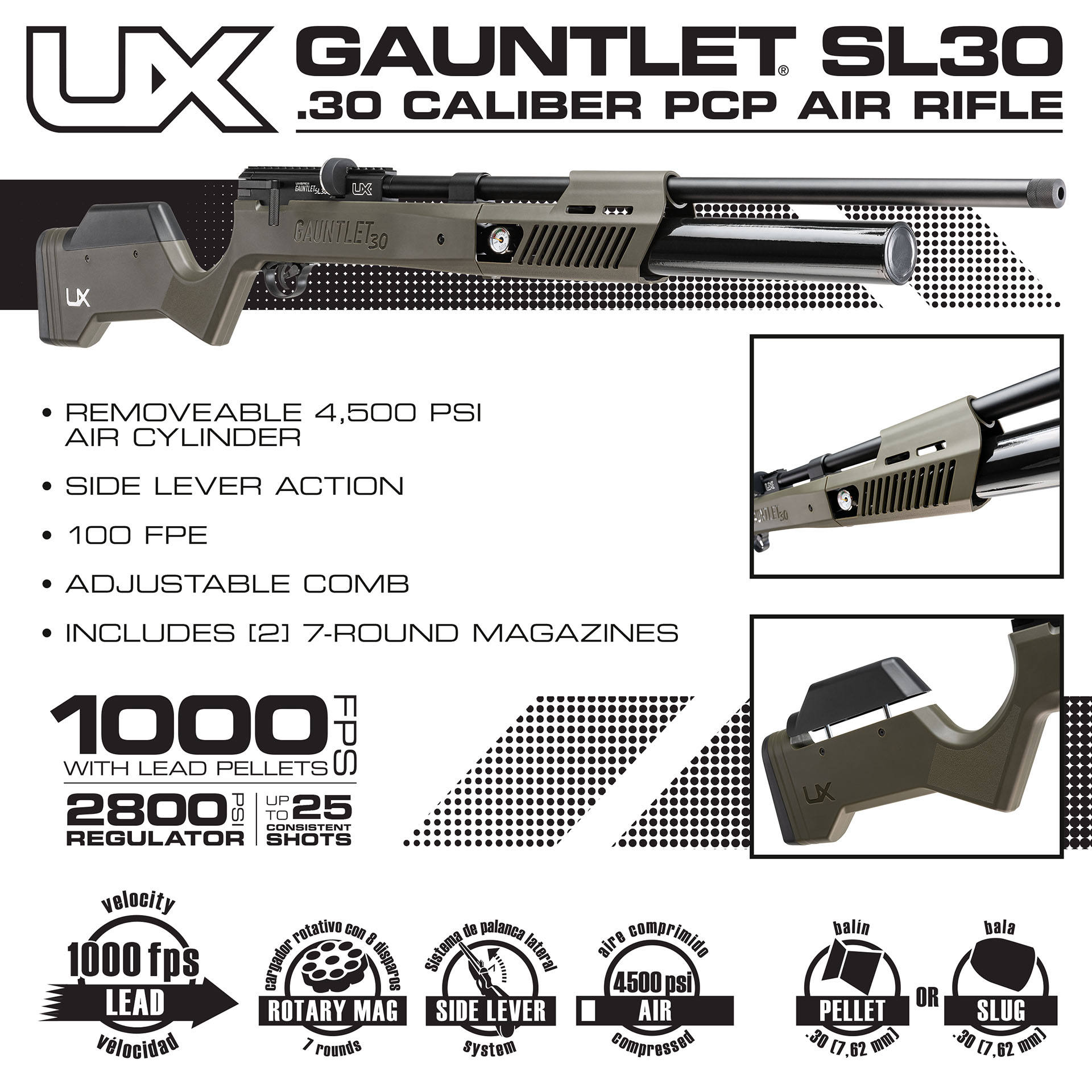
Other rifles represent a more conventional fill-first, shoot-many ownership model. The Umarex Iconix .22 PCP Air Rifle uses an onboard 3,000 PSI tank. The UMAREX NOTOS .22 CARBINE uses a fixed tank with a maximum fill pressure of 3,625 PSI. The Gauntlet 2 PCP .22 Pellet Rifle uses a removable 24 cubic inch tank that fills to 4,500 PSI.
Step 2: The reservoir stores the pressure
Once filled, the rifle is carrying its power source onboard. This is the defining PCP feature. The shooter is no longer generating force shot by shot. The force is already there, waiting in the tank or cartridge. That is what makes the shooting experience feel different from a break barrel or other cocking-based system.
In a traditional PCP, the reservoir is usually a tank or bottle integrated into the rifle’s design. The Umarex Zelos .25 Caliber PCP is a good example because Umarex specifies a 250cc tank and a 3,625 max fill pressure. In the Notos, the fixed air tank and regulated system create a compact but still fully PCP ownership experience. In the Komplete NCR .177, the pre-charged source is the removable NitroAir cartridge rather than a hand-filled onboard tank, but the underlying concept is still the same: the rifle is charged before the shot.
This is where a lot of buyer confusion starts. The pressure-storage principle is shared, but the ownership model is not. A conventional tank-filled PCP and a NitroAir-powered PCP can both belong to the same family while asking very different things from the owner.
Step 3: The trigger releases controlled pressure
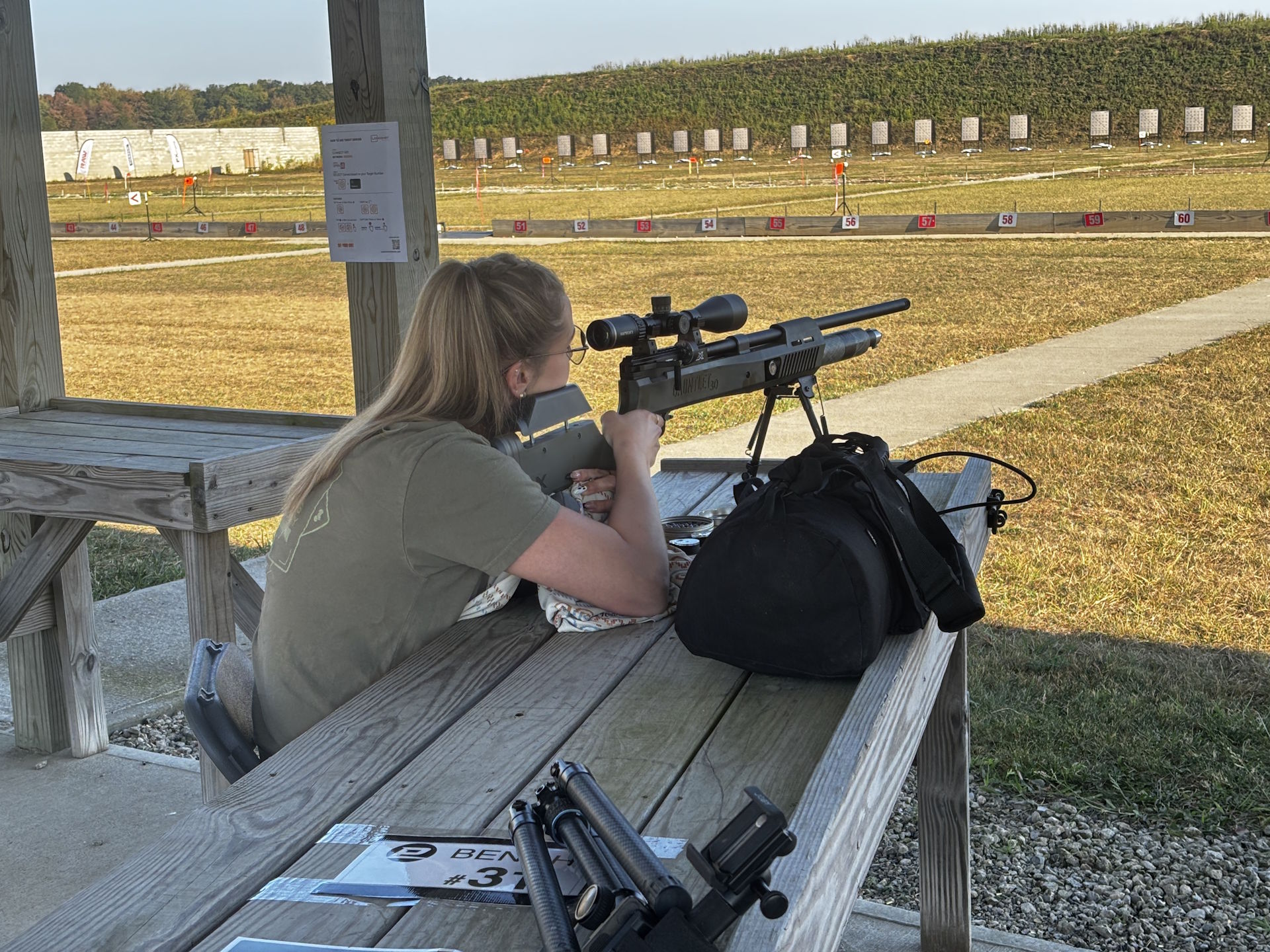
When the shooter fires, the trigger initiates a controlled pressure-release event from the stored reservoir. The exact engineering details vary by platform, but the broad operating principle is the same: the rifle meters out some of the stored pressure to propel the pellet.
This is why regulators matter so much in PCP conversations. A regulator helps control the pressure delivered to the shot cycle. The Notos is regulated at 1,900 PSI. The Zelos uses an adjustable regulator. The Komplete NCR .177 uses an internal 1,800 PSI regulator and is marketed around 45 or more consistent shots. The Gauntlet 2 .22 is also described as using a pressure regulator for consistent shot strength.
That controlled release is one of the key reasons PCP rifles are often associated with smoother and more repeatable shooting behavior. The rifle is not building force from scratch every time. It is managing a stored supply.
Step 4: The pellet is launched and the action is cycled
Once the pellet leaves the barrel, the shooter cycles the action to prepare the next round. In modern PCP use, that often means a sidelever or bolt. The Iconix is specifically described as using a smooth side-lever action. The Origin uses a compact side-mounted cocking lever. The Notos and Komplete also use sidelever systems. That is one reason PCP rifles often feel faster and easier in repeated shooting than mechanical break barrels.
This step-by-step flow matters because it shows where the effort lives in PCP. The effort is front-loaded into the fill and setup, not constantly recreated before every shot.
The Main Parts of a PCP Air Rifle
Understanding the parts helps explain why PCP rifles can vary so much even when they all share the same general operating principle.
The first key part is the air reservoir. This is where the rifle stores the compressed air or nitrogen before the shot. In practical terms, the reservoir defines a large part of the ownership model because it determines how the rifle is filled, how much air it holds, and how that air supply supports shot count and consistency.
The second key part is the regulator, when the rifle has one. Buyers do not need a graduate-level regulator lecture, but they should understand the core idea: a regulator helps control the pressure delivered to the firing system. That is why rifles like the Notos, Zelos .25, Gauntlet 2 .22, and Komplete NCR .177 all emphasize regulated or regulator-equipped operation.
The third key part is the action. In real use, this is usually a sidelever or bolt that cocks the rifle and chambers the next round. PCPs tend to feel easier to run because the action is cycling a prepared pressure system, not re-compressing the power source itself.
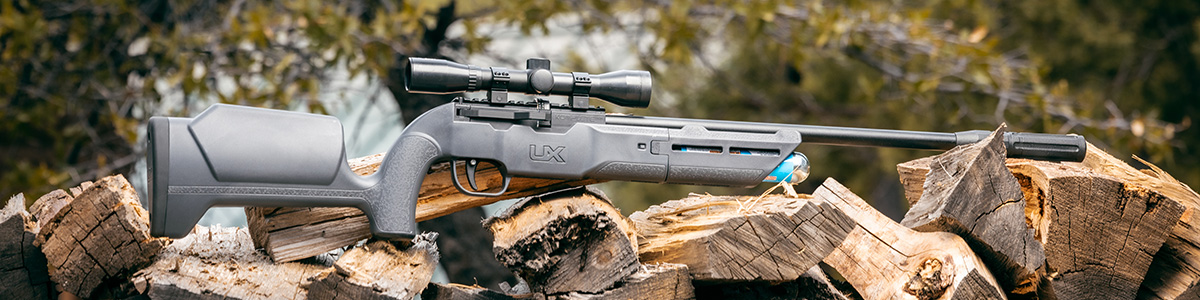
The fourth key part is the barrel and magazine system. PCP rifles often support multi-shot use, and product pages across the Umarex lineup emphasize auto-indexing magazines, sidelever operation, and repeated smooth cycling. The barrel remains the last controlled path for the pellet, but in PCP the broader system around it is designed to reduce the disruptive movement associated with many mechanical air rifles.
When these parts work together well, the result is a rifle that feels notably different from the airguns many buyers start with.
Why PCP Feels Different From Other Air Rifle Systems
The easiest way to explain PCP behavior is to compare it to what most shooters already know.
A spring piston rifle generates its working pressure through a spring and piston moving at the shot. A gas ram rifle does the same basic job through a gas strut. Both are self-contained and highly appealing for that reason, but both also bring a more involved shot cycle and a more demanding relationship with hold consistency.
A CO2 rifle is easier to shoot repeatedly because it stores gas in advance, but CO2 is not the same category as a traditional PCP reservoir or a high-pressure regulated PCP platform. It tends to live more naturally in casual convenience shooting. NitroAir-powered PCP sits in the middle of this comparison. It belongs mechanically under the PCP umbrella because it is still a pre-charged pneumatic system, but it changes the ownership model by using removable high-pressure nitrogen cartridges instead of conventional fill gear. Umarex explicitly calls Komplete “the most convenient PCP” and describes the cartridges as pre-filled with nitrogen at 3,600 PSI.
That is why PCP often feels easier to shoot well. The system reduces the kinds of movement and repeated pre-shot effort that can make other air rifles more demanding. It does not eliminate skill. It changes where the complexity lives. With PCP, the complexity usually moves into fill method, regulator behavior, and platform setup rather than staying in the shot cycle itself.
For a buyer, this is one of the biggest reasons PCP feels like a meaningful step up rather than just another air rifle subtype.
System |
Where the power is stored |
Effort between shots |
Typical ownership focus |
|
Spring piston |
Compressed spring |
Higher |
Self-contained mechanical simplicity |
|
Gas ram |
Sealed gas strut |
Higher |
Self-contained mechanical ownership with smoother shot cycle |
|
CO2 |
Gas cartridge |
Low |
Easy casual shooting and convenience |
|
Traditional PCP |
Onboard air reservoir |
Low |
Stored-pressure shooting with pump, compressor, or tank support |
|
NitroAir-powered PCP |
Removable high-pressure nitrogen cartridge |
Low |
PCP-style shooting with a simplified fill model |
The table is useful because it clarifies what “different” really means. PCP is not just smoother. It belongs to a different ownership logic than the shooter may be used to from other airgun families.
Fill Methods and Why They Define PCP Ownership
The biggest practical difference in PCP is that you do not just buy the rifle. You buy a fill strategy.
For some shooters, that is no problem at all. They are willing to learn pumps, compressors, or tanks because they value what PCP gives them on the shooting side. For others, that fill question is the deciding factor in whether the rifle still feels exciting after the purchase.
This is why rifles like the Origin matter so much strategically. The Origin lowers the barrier by being sold as a kit with a hand pump and by using a design Umarex says cuts pumping effort down by half. The Iconix lowers the barrier in a different way by being positioned as easy to fill with its 3,000 PSI onboard tank. The Komplete lowers the barrier from the opposite direction by taking pumps and compressors out of the equation entirely. Each of these rifles is not just a product. It is an ownership answer.
This is also why a good PCP education page should not pretend every buyer needs the same fill setup. A serious shooter with a Gauntlet 2 .22 or Zelos .25 may be perfectly comfortable with more conventional PCP infrastructure. A first-time PCP buyer may want the softest possible landing. A Komplete buyer may specifically want to bypass the whole conventional fill conversation.
For the full ownership logistics page, go next to How to Fill a PCP Air Rifle: Hand Pumps, Compressors, Tanks, and NitroAir Explained. That is usually the most useful supporting page after this one.
What PCP Buyers Usually Care About Most
Once people understand the broad mechanics, their questions become much more practical.
They want to know whether the rifle is easy to fill. They want to know if the shot count is enough for how they shoot. They want to know whether regulation matters. They want to know if a compact PCP can still feel serious. They want to know whether they are buying a true first PCP or a platform that assumes they already understand the category.
This is where the current Umarex lineup becomes useful as an educational map. The Origin and Iconix are natural first-PCP discussions. The Notos is the compact PCP conversation. The Zelos and Gauntlet are stronger examples of more advanced traditional PCP ownership. The Komplete is the conversation about PCP performance with a different fill philosophy.
The underlying principle is simple: PCP buyers care about the rifle, but they care just as much about what the rifle asks of them after purchase. That is what the best educational content should help them see early.
Who a PCP Air Rifle Is Best For
PCP makes the most sense for shooters who want one or more of the following.
They want a smoother, easier shot cycle than a break barrel or other mechanical rifle usually offers. They want multi-shot capability and easier follow-up shooting. They want more consistency over strings of fire. They are comfortable adopting some kind of fill strategy, or they specifically want a PCP ownership model that minimizes that burden.
That broad appeal is exactly why PCP continues to grow. It supports the first-time buyer who wants to enter the category through an Origin or Iconix. It supports the compact-utility buyer who likes the Notos. It supports the more advanced traditional PCP buyer who wants the regulator and tank architecture of a Zelos or Gauntlet. And it supports the buyer who likes the idea of PCP but wants Komplete’s NitroAir model instead of conventional fill gear.
PCP is not always the best answer, though. A shooter who values absolute self-contained independence above everything else may still prefer a spring or gas ram rifle. A shooter who wants the simplest casual cartridge system may still prefer CO2. PCP earns its place when the buyer values stored-pressure performance enough to accept the ownership model that comes with it.
That is the real dividing line.
What Buyers Usually Get Wrong About PCP
The first mistake is assuming PCP automatically means complicated. That is no longer a good blanket assumption. The Origin, Iconix, and Komplete all exist because different kinds of buyers want easier access to the category.
The second mistake is assuming PCP automatically means expensive in practice. Some PCP ownership models are definitely more gear-intensive than others, but not every rifle requires the same support setup. That is why separating the fill-method decision from the rifle decision is so important.
The third mistake is thinking PCP answers the “best rifle” question by itself. It does not. PCP is a family of systems. A buyer still has to decide caliber, fill method, compactness versus capacity, regulation preferences, and use case. That is why this page should naturally lead into .177 vs .22 vs .25 PCP Air Rifles: Which Caliber Is Best?, Best Entry-Level PCP Air Rifles: How to Choose Your First PCP (https://www.umarexusa.com/best-entry-level-pcp-air-rifles), PCP Air Rifle Accuracy: What Affects Groups, Consistency, and Shot Count (https://www.umarexusa.com/pcp-air-rifle-accuracy-guide), and NitroAir vs Traditional PCP: Which Ownership Model Makes More Sense?
The better workflow is simple: understand the PCP concept, choose your fill logic, choose your caliber lane, then choose the platform.
Key Takeaways
-
A PCP air rifle stores high-pressure air or nitrogen before the shot and releases controlled pressure when fired.
-
PCP usually feels smoother and easier to shoot repeatedly than spring or gas ram systems because the shooter is not rebuilding the power cycle before every shot.
-
Traditional PCP and NitroAir-powered PCP belong to the same broad family, but they create different ownership experiences.
-
Reservoir size, regulator design, fill pressure, and fill method all matter because PCP is an ownership model as much as it is a shooting system.
-
Entry-level PCP, compact PCP, advanced traditional PCP, and NitroAir-powered PCP are different lanes inside the category.
-
For the next step, go to How to Fill a PCP Air Rifle: Hand Pumps, Compressors, Tanks, and NitroAir Explained and .177 vs .22 vs .25 PCP Air Rifles: Which Caliber Is Best?
FAQ
What does PCP mean in an air rifle?
PCP means pre-charged pneumatic. It refers to an air rifle that stores high-pressure air or nitrogen before the shot, then releases that pressure to propel the pellet.
How is a PCP rifle different from a spring piston rifle?
A PCP stores the pressure in advance. A spring piston rifle generates working pressure during the shot through a spring and piston. PCP usually feels smoother and requires less effort between shots.
Does a PCP air rifle need to be pumped before every shot?
No. That is one of the key differences in the category. A PCP is filled in advance, then uses that stored pressure for multiple shots.
Is Komplete really a PCP air rifle?
Yes. Umarex includes Komplete in its PCP lineup and describes it as a NitroAir-powered PCP pellet rifle. It is best understood as a secondary NitroAir-powered PCP ownership branch within the larger PCP category.
Are PCP rifles more accurate?
PCP rifles are often easier to shoot consistently because they usually have a smoother shot cycle and less disruptive firing behavior than many mechanical systems. But practical accuracy still depends on pellets, optics, technique, and platform setup.
What is the easiest PCP rifle to start with?
That depends on what kind of “easy” you mean. The Origin lowers the barrier for pump-based traditional PCP ownership, the Iconix is designed as an accessible conventional PCP, and Komplete simplifies the fill side by using NitroAir cartridges.
Works Cited
-
Umarex USA. “PCP Air Rifles.” Umarex USA. https://www.umarexusa.com/pcp-air-rifles
-
Umarex USA. “Umarex Origin .22 cal PCP Air Rifle Kit with Pump.” Umarex USA. https://www.umarexusa.com/umarex-origin-22-cal-pcp-air-rifle-with-high-pressure-air-hand-pump
-
Umarex USA. “Umarex Iconix .22 PCP Air Rifle.” Umarex USA. https://www.umarexusa.com/umarex-iconix-22-pcp-air-rifle-2252135
-
Umarex USA. “UMAREX® NOTOS .22 CARBINE.” Umarex USA. https://www.umarexusa.com/2254847
-
Umarex USA. “Umarex Zelos .25 Caliber PCP.” Umarex USA. https://www.umarexusa.com/umarex-zelos-25-caliber-precision-pre-charged-pneumatic-pellet-rifle-2251543
-
Umarex USA. “Gauntlet 2 PCP .22 Pellet Rifle.” Umarex USA. https://www.umarexusa.com/umarex-gauntlet-2-hpa-air-rifle-22-pellet-gun-2254825
-
Umarex USA. “Umarex Komplete NCR .177 PCP Air Rifle.” Umarex USA. https://www.umarexusa.com/umarex-komplete-ncr-177-pcp-air-rifle-2251556
-
Umarex USA. “Komplete-ly Ready.” Umarex USA. https://www.umarexusa.com/kompletely-ready
National Shooting Sports Foundation. “Safety.” NSSF. https://www.nssf.org/safety/